| The expansion of Islam in West Africa was largely peaceful. The introduction of camels for transportation into the Sahara sometime before AD 600 had established a growing network of caravan routes between the Maghreb and the Sahil (shore), the vast belt of grassy steppelands that lies between the Sahara and the tropical forests of Guinea. The principal export from the south was gold from Bambuko on the Senegal River, which was for centuries the principal source of gold for the Maghreb, West Asia, and Europe. Gold — along with slaves, hides, and ivory — was exchanged for copper, silver, handcrafted articles, dried fruits, and cloth. More significant than the trade, however, was the diffusion of ideas. Islam was brought south by merchants, teachers, and Sufi mystics the French had named Marabouts -- Arabic Murabits. The latter were often members of saintly families who acted as hereditary arbiters among rural tribesfolk. |
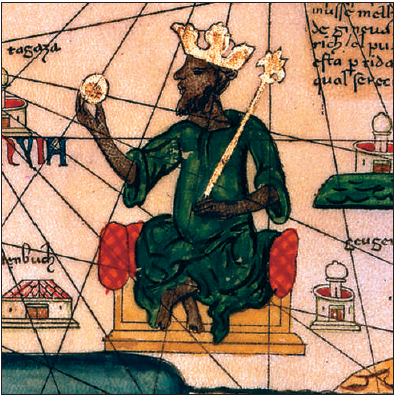
Detail from a fourteenth-century Catalan map showing a king enthroned, with his royal regalia. The portrait may be of Mansa Musa of Mali, whose wealth made a great impression on his contemporaries when he traveled to Mecca in 1324–25.
|
| In the eleventh century Murabits from the Lamtuna Berber group established a center in Mauretania for the propagation of Islam, from where they launched a jihad against the kings of Ghana, rulers of the largest and wealthiest of the West African states. The reforming zeal of the Murabits (known as Almoravids in Spanish) carried them northward to Iberia, where they reunited the petty principalities of al-Andalus to ward off the threat of the Christian reconquest. There were some forcible conversions of Africans south of the Sahara, but these were mostly rare. The earliest converts were usually the royal families that had always relied on religious prestige to extract taxes or military service from subordinate clans and communities. As Muslim merchants settled in Sahil cities (most of which had their own Muslim quarters by the late tenth century) the royals would seek to benefit from the cultural prestige they carried by adopting Islam as the court religion. |
| For the most part local kingdoms continued to form and re-form under different tribal dynasties, with Islamic rituals and practice intermingling with tribal customs. With each new state the capital would become a center of wealth and Islamic learning, as rulers sought prestige by patronizing religious scholarship. The most spectacular cultural center was the Tuareg city of Timbuktu on the Niger. The Tuaregs were a camel-borne elite who grew rich from the trans-Saharan trade, using slaves to exploit the salt mines and settling serfs from African tribes to cultivate the oases along their routes. |
| The most celebrated Muslim ruler from Subsaharan Africa was Mansa Musa (1307–32), king of Mali. He made the pilgrimage to Mecca in 1324–25 in the grandest possible style, leaving an impression that would last for generations. Unlike the Nilotic Sudan where the Arabic language took root, Islam was diffused in local vernaculars from a relatively early stage. From around 1700 (and possibly earlier) scholars and teachers developed a modified version of Arabic script to convey Islamic teachings in Fulfulde and Hausa, the leading languages of the western Sahil. |

|
| Back to Table of Contents |
|
